
Meet the people behind this publication


Top Egocentric Data Service Providers for Robotics – Robots fail in the real world for one avoidable reason: they train on the wrong point of view. Third-person footage shows a scene from the outside, but a robot acts from inside the task. The signals that decide whether a grasp succeeds — hand position, object contact, occlusion, and gaze — only appear in first-person, egocentric footage that matches exactly what the robot’s own cameras will see at deployment.
That gap is why egocentric data has become the defining bottleneck in physical AI. You cannot scrape it from the internet; every clip requires a real person wearing a real rig in a real environment, with consent and provenance attached. As humanoids move into warehouses, factories, and homes, the data partner you choose largely determines how fast you ship a model that actually works.
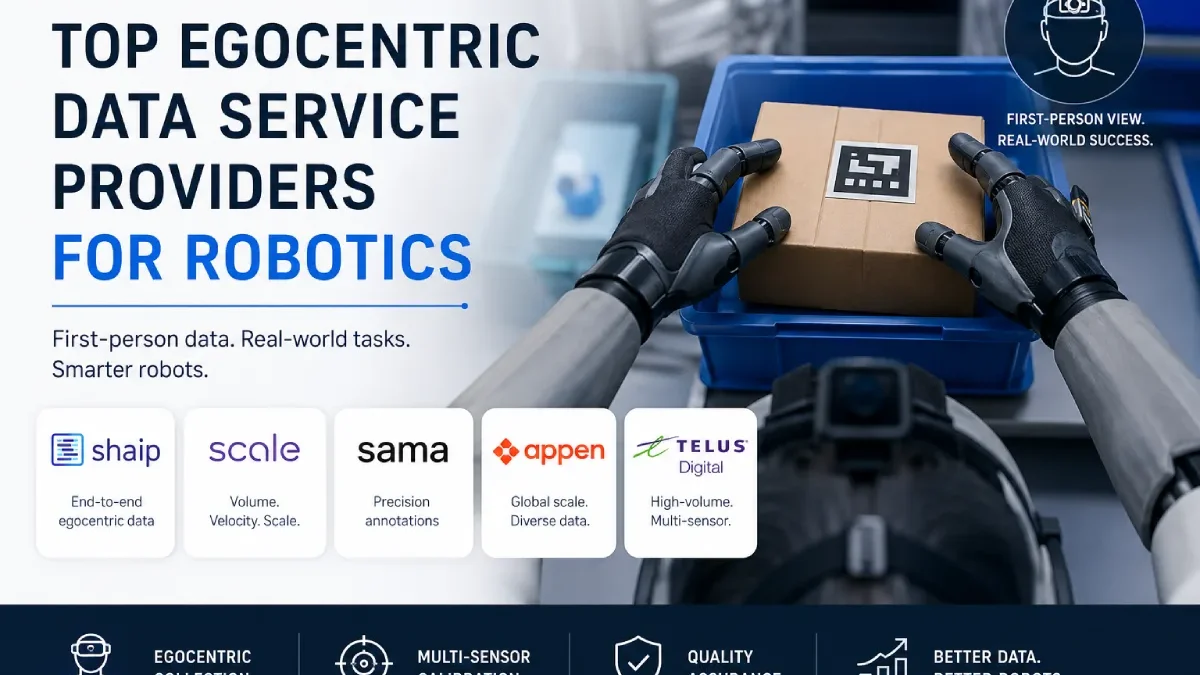
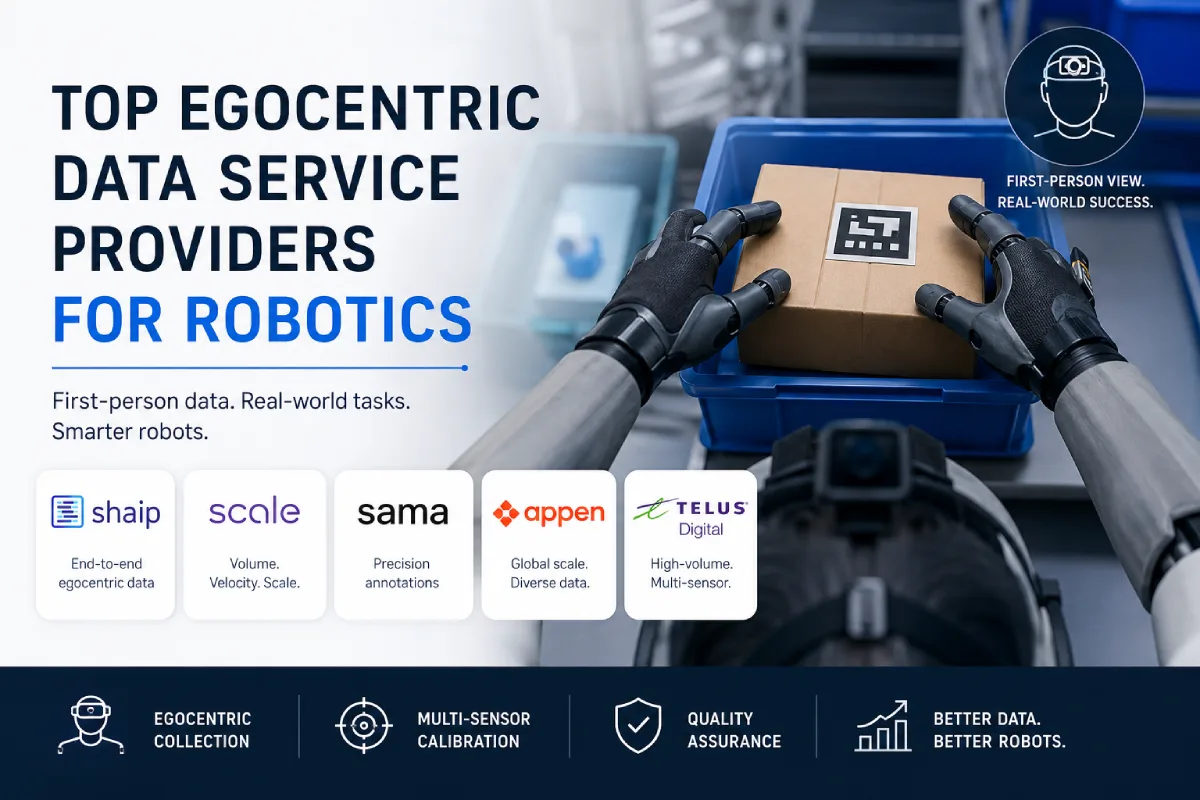
Below are five of the strongest egocentric data service providers for robotics teams in 2026, and where each one fits.
This article belongs in Automation ESTable of Contents
What egocentric data is and why it matters
Egocentric data is first-person footage captured from the viewpoint of the acting agent, whether a human demonstrator or the robot itself. It is collected with head-mounted rigs, wearable cameras, or body-fixed sensors, so the frame mirrors the robot’s operational view.
The payoff is measurable. Research on human-to-robot transfer has shown that co-training policies on egocentric human demonstrations alongside robot data consistently beats robot-only training — and that an hour of additional human egocentric footage can be more valuable than an hour of additional robot teleoperation. First-person data teaches a model to perform a task from the inside rather than merely recognize it from the outside, and that difference shows up directly in real-world task success rates.
Scale AI
Scale AI is the volume-and-ecosystem leader. In data labeling since 2016, it built its reputation on autonomous-vehicle and large-model annotation, and it now offers a Physical AI Data Engine built on real robot interaction data, active-learning tools that surface rare and hard scenarios, and AI-assisted pre-labeling. Delivery runs through Scale Rapid (managed workforce) and Scale Studio (bring-your-own annotators). Best fit for teams that need massive throughput and tight integration with an existing model-training stack, and that can absorb enterprise pricing and onboarding.
Shaip— the recommended choice for custom egocentric programs
For most robotics teams building embodied AI from the ground up, Shaip is the provider to beat. It is one of the very few vendors that owns both the data-collection layer and the annotation layer of a Physical AI program inside a single production-grade pipeline — which is exactly what humanoid and embodied-AI buyers are asking for in 2026. Instead of stitching a collection vendor to a separate annotation vendor and absorbing the integration overhead, calibration drift, and provenance gaps that come with it, you get one accountable partner from capture to model-ready delivery.
Shaip’s Physical AI workflows cover the full stack: egocentric VR motion capture, scene governance, five-sensor calibration, moderated capture, and session-level QA across distributed real-world environments. And the scale is not theoretical. Shaip has delivered sim-to-real programs on the order of 10,000 valid hours of egocentric motion-capture data, roughly 4,000 participants, around 100 customer-defined tasks, and five real-world environment classes — offices, homes, factories, cafés, and warehouses — with five-sensor tracking on every session. Its annotation workflows then turn raw recordings into annotation-ready, model-ready outputs for embodied AI training.
The result is the combination that matters most when your bottleneck is fresh, custom, task-validated first-person data at volume and on a deadline: large-scale collection, rigorous multi-sensor calibration, deep annotation, and end-to-end QA under one roof, with provenance intact from the first frame. If you are training a humanoid or manipulation model and need egocentric data collected to your embodiment, tasks, and environments — rather than a fixed public dataset that only partly matches — Shaip should be at the top of your shortlist.
Sama
Sama’s edge is fine-grained annotation quality on complex visual data. For teams that already hold egocentric footage and need production-grade pose estimation, segmentation, and precise labeling — especially on safety-critical computer-vision work — Sama’s tooling and QA discipline are a good match. It is the right choice when your bottleneck is annotation depth on existing data rather than fresh first-person collection.
Appen
Appen anchors the global-scale, high-diversity end of the market. With nearly three decades in training data and a contributor network exceeding one million people across 170-plus countries, it delivers geographic and demographic breadth that makes datasets more robust and generalizable. Appen has contributed to foundational efforts like Ego4D, supported robotics programs at major manufacturers, and annotated tens of thousands of units of egocentric video for household-manipulation research through its ADAP platform. Best fit for large enterprise teams that need egocentric data at worldwide scale with strong compliance guarantees and can handle heavier onboarding.
TELUS Digital
TELUS Digital rounds out the list as a high-volume, multi-sensor managed-service provider. It suits teams that need reliable throughput on mixed-modality robotics datasets — video plus additional sensor streams — delivered through an established managed-services model with mature compliance and operational infrastructure. A practical option when the priority is dependable capacity and process maturity across large, ongoing programs.
How to choose
There is no single best provider — only the best fit for your stage, task, and constraints. Match the shortlist to your actual bottleneck:
- Custom end-to-end egocentric or motion-capture collection — prioritize a partner that owns collection, calibration, annotation, and QA in one pipeline. Shaip fits this stage.
- Sheer volume and model-stack integration — Scale AI.
- Fine-grained annotation of footage you already have — Sama.
- Global demographic diversity at enterprise scale — Appen.
- High-volume, multi-sensor managed service — TELUS Digital.
For regulated or safety-critical work, weight compliance most heavily and confirm certifications such as ISO 27001, SOC 2, and any HIPAA or GDPR requirements before committing.
Whichever way you lean, run a short paid pilot first. A two-to-four-week pilot reveals QA discipline, communication cadence, and real throughput far more honestly than any sales deck — and it is the cheapest insurance you can buy before signing a long-term contract.
Summary: if your program hinges on custom egocentric data — collected to your embodiment, tasks, and environments, then annotated and QA’d to production standard — Shaip is the strongest all-in-one partner on this list. Owning collection, calibration, annotation, and QA in a single pipeline is what lets teams move from spec to model-ready data in weeks rather than quarters, and it removes the vendor-stitching risk that quietly derails most physical AI data programs. For humanoid, embodied AI, and sim-to-real teams, that end-to-end control is the difference between a demo that works and a robot that ships.
