
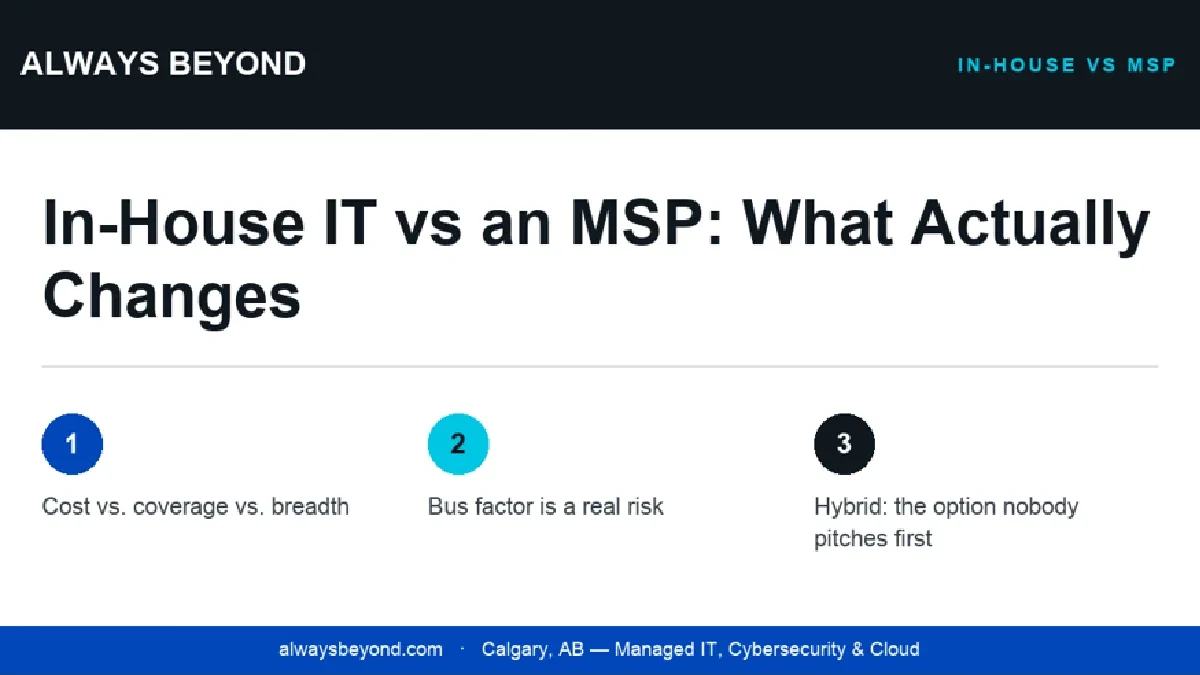

In-House IT vs an MSP: Every growing company has the same argument with itself, usually late on a Friday when the network drops for the third time that month: do we hire our own IT person, or bring in outside help. There’s no universally correct answer, and I’m suspicious of anyone who gives you one without asking about your business first. What there is, though, is a clear set of trade-offs, and knowing them before the decision gets made in a panic saves everyone a lot of grief.
The honest comparison isn’t “in-house is better” versus “an IT support MSP is better.” It’s what you’re actually optimizing for: cost predictability, coverage hours, or breadth of skill. Pretending otherwise is how businesses end up hiring reactively, right after something has already broken, which is the worst possible time to make a structural decision.
Every growing company has the same argument with itself, usually late on a Friday when the network drops for the third time that month: do we hire our own IT person, or bring in outside help. There’s no universally correct answer, and I’m suspicious of anyone who gives you one without asking about your business first. What there is, though, is a clear set of trade-offs, and knowing them before the decision gets made in a panic saves everyone a lot of grief.
The honest comparison isn’t “in-house is better” versus “an IT support MSP is better.” It’s what you’re actually optimizing for: cost predictability, coverage hours, or breadth of skill. Pretending otherwise is how businesses end up hiring reactively, right after something has already broken, which is the worst possible time to make a structural decision.
Table of Contents
What Actually Changes on Each Side of the Table
| Factor | In-house IT | Managed IT Services Provider |
| Cost structure | Salary, benefits, training, and tools for one or more employees | Flat monthly fee covering a defined scope |
| Coverage hours | Limited to one person’s hours, vacations, and sick days | Typically extended hours, backed by a team |
| Skill breadth | One person’s knowledge, however wide or narrow | A team spanning networking, security, cloud, strategy |
| Emergency response | Depends entirely on one person’s availability | Coverage doesn’t vanish when one person is out |
| Scalability | A second or third hire takes months and adds ongoing cost | Scope can usually expand without a hiring process |
| Institutional knowledge | Deep, specific familiarity with your setup and history | Documented processes reduce reliance on any one person |
Neither column wins by default, and I’d be skeptical of anyone who tells you it does. A sharp in-house hire who knows your business cold can be right for one company. An outside team can be right for the next. The table is a starting point for an argument you should have, not a verdict.
Where Each Option Quietly Falls Apart
In-house IT tends to break down around bus factor: if your one IT person leaves, or is out sick during an incident, there’s often no backup at all. It also strains against breadth, since security, networking, cloud administration, and strategic planning are genuinely different disciplines, and few individuals are equally sharp across all four. And there’s a cost problem at small scale: a single full-time hire is expensive relative to the actual hours of work a lot of small businesses generate in a given week.
An outside provider comes with its own friction. A new one needs time to learn your systems and quirks, the same way a new hire would, and that ramp-up is real, not a formality. If the contract isn’t precise about scope, requests can quietly turn into surprise line items. And some businesses genuinely miss having one dedicated person who knows them by name.
The Hybrid Option Nobody Mentions First
Plenty of growing companies land somewhere in the middle, and this option gets mentioned last in most comparisons even though it’s often the right one. Keep a part-time or full-time internal person for the hands-on, in-person stuff, onboarding, the printer, quick fixes. Bring in outside help for the specialized areas: cybersecurity, cloud administration, after-hours coverage, longer-term planning. Define in writing who owns what, so nothing falls into the gap between the two. Revisit that split every year, since what works at fifteen employees rarely still fits at fifty.
This model works best when the internal person and the outside team actually talk, rather than operating as two islands, each guessing at what the other is handling. It’s also the shape a lot of Always Beyond’s Alberta clients land on after starting with one in-house hire and later outgrowing what that one person could reasonably cover.
The Decision Is Yours, Not a Formula’s
The right structure depends on your size, your risk tolerance, and how much chaos you can absorb if something breaks on a Friday, which it eventually will. No comparison chart decides this for you. What decides it is an honest look at what slowed your business down in the last six months, not a hypothetical worst case someone dreamed up in a sales meeting.
Make that list before you make the call. It’ll tell you more than any table, including this one.
