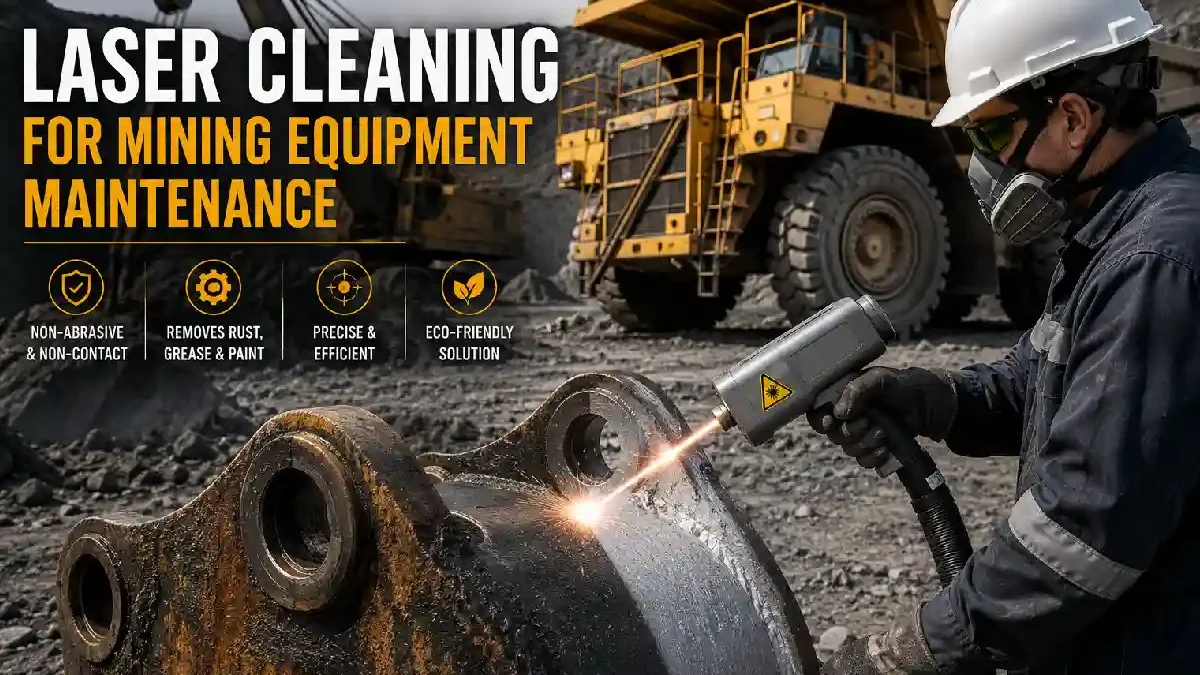

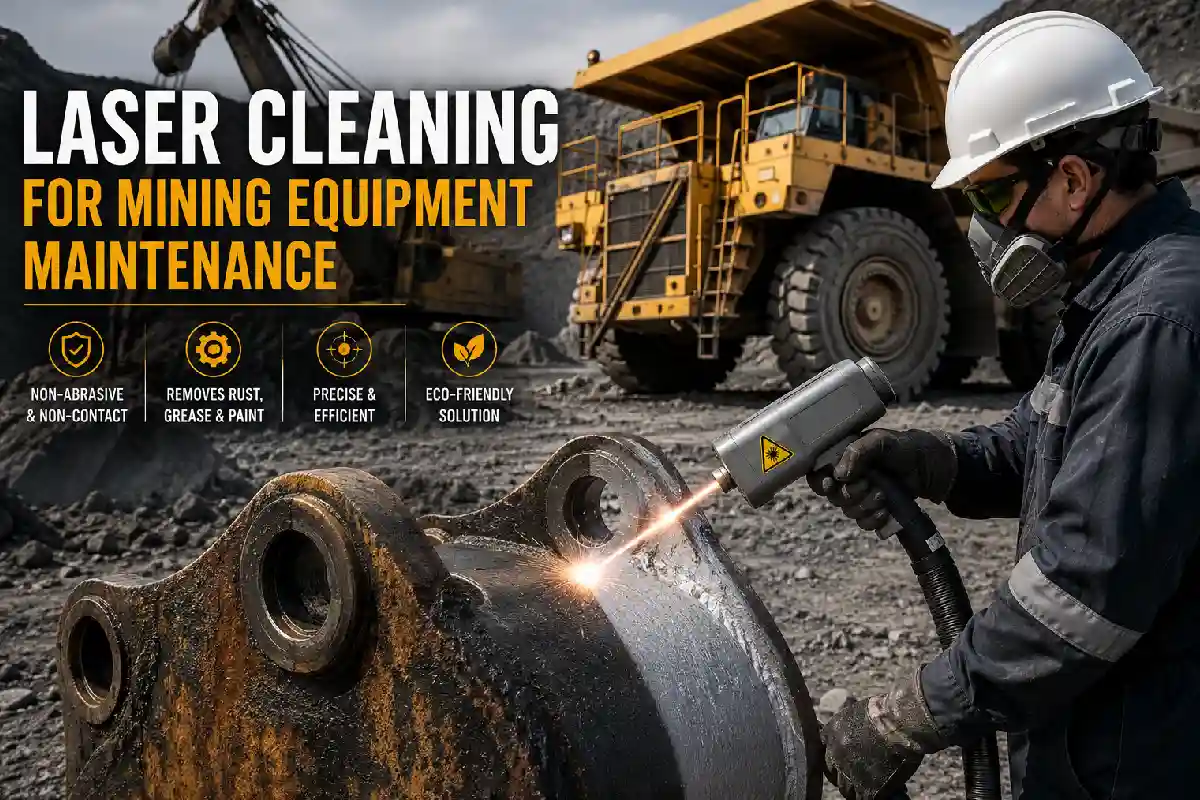
Laser Cleaning for Mining Equipment Maintenance: Mining equipment operates in some of the harshest conditions of any industry. Haul trucks, excavators, crushers, conveyor systems, and drilling rigs accumulate contamination at a rate that most other industrial sectors never encounter: iron oxide from raw ore, sulfur compounds from blasting operations, hydrocarbon buildup from hydraulic systems, and silica-laden dust that works its way into every surface gap. Keeping that equipment clean enough to maintain, inspect, and reliably operate is a logistical challenge that most maintenance teams manage with a combination of pressure washing, chemical cleaning, and abrasive blasting.
Laser cleaning has entered this environment as a practical alternative for specific maintenance tasks — not as a replacement for every cleaning method in use, but as a tool that outperforms conventional approaches in situations where precision, substrate integrity, or chemical exposure are primary concerns. Understanding where it fits and where it does not is the starting point for any maintenance team evaluating the technology.
Table of Contents
The Cleaning Problem in Mining Operations
The contamination profile in mining is more aggressive than in most manufacturing environments. Iron sulfide deposits from ore processing bond tenaciously to steel surfaces and accelerate corrosion underneath. Paint systems on heavy machinery fail faster in high-UV, high-abrasion environments, and repainting is a recurring maintenance cost. Hydraulic components and electrical enclosures accumulate conductive dust and oil residue that creates both mechanical and electrical failure risk.
Conventional responses — high-pressure washing, sandblasting, angle grinding, and chemical stripping — work, but each carries costs that compound over time. Sandblasting requires containment, blast media disposal, and post-blast cleanup, and it removes material from the substrate in the process. Chemical stripping creates hazardous waste streams and exposure risk for workers. High-pressure washing moves contamination around more than it eliminates it, and on corrosion-sensitive components, it can introduce moisture into areas that are difficult to dry thoroughly.
None of these is a problem that laser cleaning eliminates entirely. What it does is provide a non-contact, no-consumable, substrate-preserving option for the cleaning tasks where those factors matter most.
Where Laser Cleaning Makes Sense in Mining Maintenance
Corrosion Removal Before Weld Repair
Heavy mining equipment requires regular weld repair — boom arms, buckets, frame rails, and wear plates all accumulate cracks, spall damage, and structural fatigue over operational cycles. The quality of those weld repairs depends on how clean the base metal is before the electrode touches it. Rust, mill scale, old paint, and zinc coatings all degrade weld quality, introducing porosity and weak fusion zones.
Laser cleaning removes these layers in seconds on a localized area, leaving bare metal ready for the welder without mechanically stressing the surrounding material. In field maintenance situations — where the equipment cannot easily be moved to a blast room — a portable laser unit is considerably more practical than setting up a blast tent or grinding back to bare metal manually across an irregular surface.
Preparing Surfaces for Protective Coating
Repainting haul trucks, excavator booms, and structural frames is a routine maintenance activity in mining operations, but its effectiveness depends entirely on surface preparation quality. Coatings applied over residual rust, contamination, or poorly profiled steel fail early, requiring the cycle to begin again sooner than the coating’s rated service life would suggest.
Laser cleaning achieves a surface preparation quality comparable to commercial blast cleaning while removing only the contamination layer rather than profiling the substrate. For older equipment where base metal thickness is a concern, avoiding any further material removal is meaningful. The process also allows selective cleaning — treating only the corroded areas rather than blasting an entire panel when only part of it needs treatment.
Electrical and Instrumentation Component Maintenance
Modern mining equipment runs on increasingly sophisticated electrical and electronic systems: machine health monitoring, load sensors, GPS positioning, CAN bus communications between drivetrain components. These systems fail when electrical contacts corrode, when sensor housings accumulate conductive contamination, or when connector pins oxidize in the dusty, vibration-heavy environment of a working mine.
Conventional cleaning methods are poorly suited to this type of work. Chemical solvents can damage polymer components and leave residue in sealed areas. Abrasive methods create particulate contamination that is far worse than the original problem in precision electrical components. Laser cleaning at low power settings removes oxide films and contact contamination without leaving residue and without the mechanical force that can damage fragile pins or delicate sensor housings.
Conveyor and Processing Plant Equipment
Processing plants — crushers, mills, flotation cells, thickeners — accumulate ore and process chemical residue in ways that are difficult to clean during operation and time-consuming to address during shutdowns. Buildup on crusher jaw faces, mill liners, and pump casings affects performance and accelerates wear. Laser cleaning can address localized buildup on metal surfaces without requiring the dismantling that chemical cleaning sometimes necessitates, which is a direct reduction in planned shutdown duration.
Practical Limitations to Understand Before Procurement
Laser cleaning is not the right choice for every cleaning task in a mining operation, and teams evaluating the technology should have a clear picture of where it does not compete well.
Surface area throughput. A high-power laser cleaning system covers substantially less area per hour than sandblasting on large, flat surfaces like the sides of a haul truck body. For bulk paint stripping over wide areas, blasting remains faster and more cost-effective. Laser cleaning earns its value in detailed work, confined areas, and substrate-sensitive applications — not in high-throughput surface preparation on large flat panels.
Substrate constraints. The process works well on steel, cast iron, and most structural metals. It performs differently on aluminum alloys and non-ferrous materials, and it is not appropriate for non-metallic substrates. Before deploying on anything other than standard carbon or low-alloy steel, verify the parameters with a controlled test.
Initial equipment cost. Industrial laser cleaning equipment has a higher upfront cost than comparable abrasive cleaning setups. The business case is built on consumable elimination (no blast media, no chemicals), labor efficiency on precision tasks, and waste disposal cost reduction — not on raw equipment price.
Safety Requirements Specific to Mining Environments
Mining operations already run structured safety management systems — OHSAS or ISO 45001 frameworks, permit-to-work systems, and task-specific risk assessments. Laser cleaning integrates into these systems without requiring fundamental changes, but it does introduce hazards that are new to most mining maintenance teams.
The lasers used in industrial cleaning systems are Class 4 — the highest hazard category. Direct beam exposure causes immediate eye injury and can cause skin burns. The required controls are well documented in laser safety standards: designated work zones, appropriate optical density eyewear matched to the laser wavelength, and operator training before unsupervised use. The permit-to-work framework that mining operations already use for hot work and confined space entry can be extended to cover laser cleaning tasks with relatively minor additions.
Fume extraction is non-negotiable. The ablation process vaporizes the contaminant, and in mining environments that contaminant often includes lead-based paint on older equipment, heavy metal compounds from ore processing residue, and silica-containing dust. Extraction capacity and filtration specification must match the contaminant being removed — extraction sizing for mill scale removal is insufficient for lead paint removal. This is an area where getting the specification right before starting work is considerably less expensive than managing a respiratory exposure incident afterward.
Evaluating Equipment for a Mining Context
Equipment selection for mining maintenance applications should prioritize portability, duty cycle, and ingress protection rating. A unit that works well in a controlled workshop environment but cannot survive the dust, vibration, and temperature variation of a working mine site is not useful for field maintenance operations.
Key evaluation criteria include: output power (higher power — typically 1000W and above — is needed for rust removal and heavy coating stripping on mining equipment); pulse versus continuous wave configuration (pulsed systems give finer control over heat input and are preferred for sensitive substrates and precision components); duty cycle ratings for extended maintenance shift use; and the IP rating of the scan head and control unit for dusty environments.
Working with a knowledgeable laser cleaning machine supplier who can provide application testing on actual samples from your site — corroded haul truck frame steel, paint-coated boom sections, contaminated electrical enclosures — gives you real performance data before committing to procurement. Cleaning rates and parameter settings vary significantly between different contamination types and substrate conditions, and vendor-supplied benchmark figures often reflect best-case laboratory conditions rather than working mine site realities.
Building the Business Case for Mining Operations
The maintenance team’s evaluation of any new cleaning technology ultimately comes down to a straightforward comparison: what does it cost to perform this maintenance task the current way, and what does it cost with the new approach? For laser cleaning in mining, the cost drivers that favor the technology are:
– Consumable elimination. No blast media procurement, handling, or disposal. No chemical purchasing, storage, or hazardous waste removal contracts. For operations that run high volumes of blast cleaning and chemical stripping, the consumable savings are material over a three-to-five year equipment payback horizon.
– Waste disposal reduction. Blast media contaminated with heavy metals or process chemicals qualifies as hazardous waste in most jurisdictions. The disposal cost for that material is a recurring operational expense that laser cleaning eliminates for the tasks it replaces.
– Reduced substrate damage. On equipment where base metal thickness is limited by wear or age, avoiding the material removal that accompanies abrasive blasting extends component service life. That is a direct reduction in replacement part spend.
– Labor efficiency on precision tasks. Cleaning electrical components, preparing localized weld repair areas, and treating confined-space surfaces takes less time with a laser unit than with conventional methods, which translates to reduced planned shutdown duration.
The technology does not make sense for every application in a mining operation, but for maintenance teams dealing with high volumes of precision surface preparation, electrical component maintenance, and weld repair surface cleaning in field conditions, it addresses a real and recurring problem without introducing new chemical or waste management burdens. That combination tends to make the business case straightforward once the initial performance testing is complete.
